
SCOPIOUS / WORKFLOW AUTOMATION
Workflow Automation Services for Businesses
Workflow automation services for businesses: connect forms and systems, prevent duplicate actions, handle failures and document safe handover.
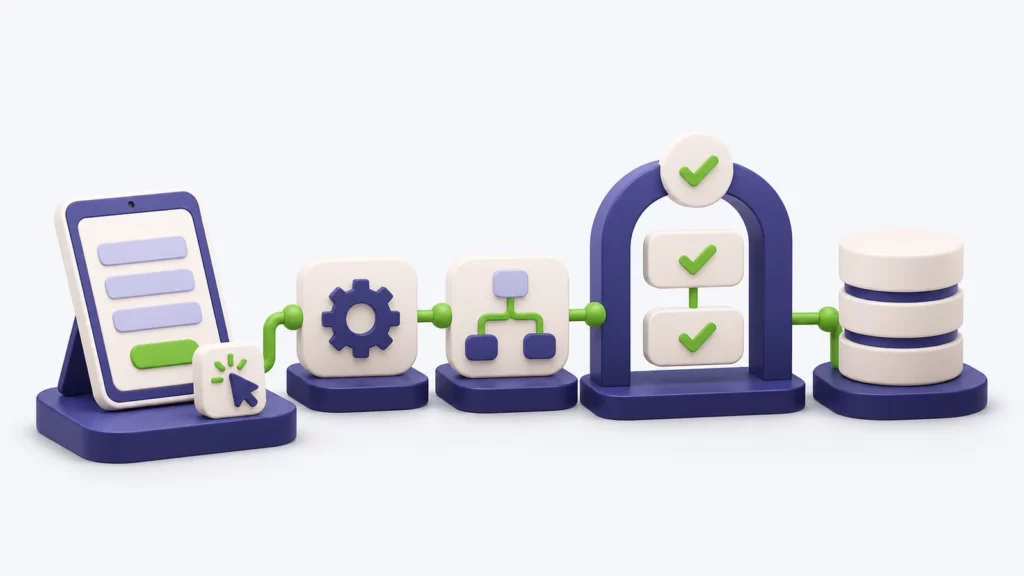
When teams move requests manually between systems, missed follow-ups and duplicate records become more likely.
Workflow automation begins with the manual process, trigger conditions, owners and the systems involved. A maintainable delivery includes clear data mapping, safe retry rules, duplicate prevention, failure alerts and handover documentation. We use AI only where it improves a defined step and where risks can be reviewed.
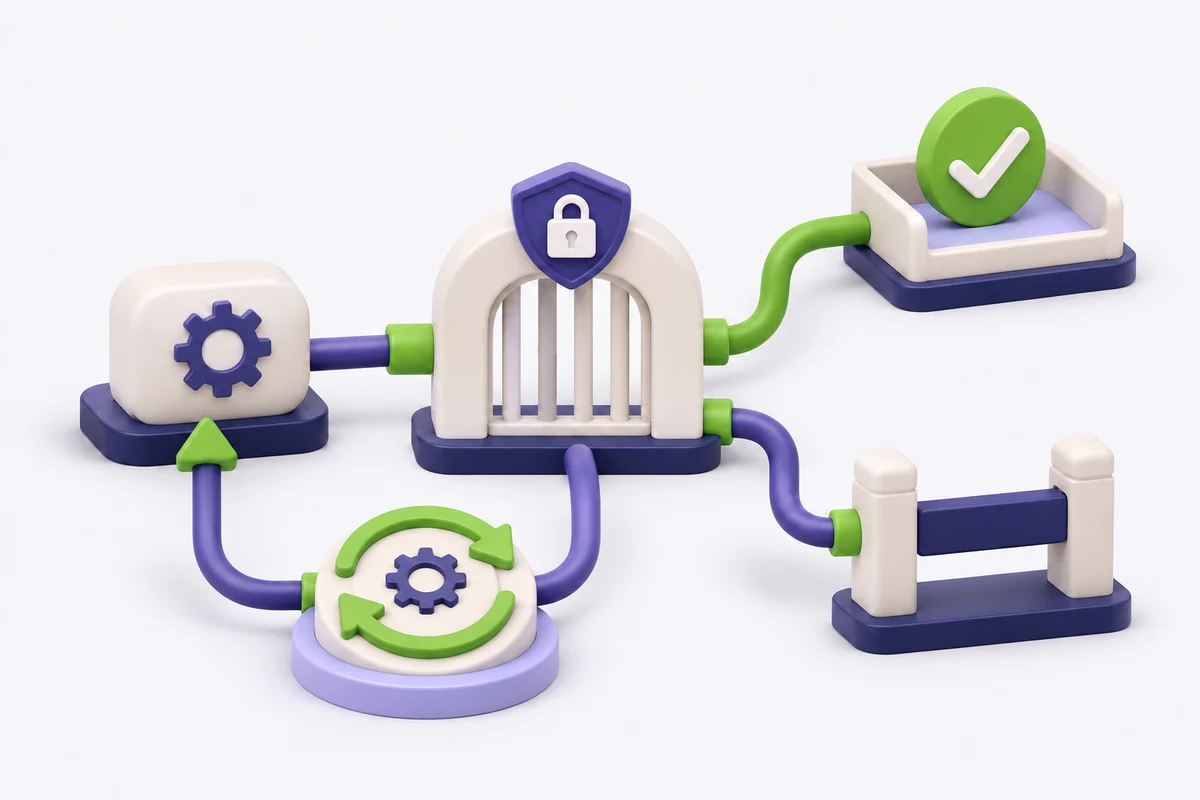
Automation must still work when a step fails
Imagine a lead form that is submitted twice, followed by a CRM outage. The workflow needs an identity key, a durable record of what has already been processed and a retry policy that does not create a second customer or notify several employees unnecessarily. We document which step owns each transition and when a human should intervene.
Choose the right type of automation: a reliable workflow starts from a defined trigger, a data contract, the expected outcome and rules for failures. For example, a new enquiry can be checked for duplicates, assigned to an authorised owner and passed to a documented follow-up queue. That is often better handled by explicit logic than by a generative model. When a request cannot be handled by deterministic rules and needs language understanding or user-facing escalation, compare AI agent development. Where an action must pass through controlled interfaces, review MCP and API integration. Acceptance criteria should cover retries, logs, permissions and the ability to recover without creating a second customer record.
A handover should name the monitoring owner, describe failed-job recovery and include tests for duplication, invalid data, lost authorisation and interrupted connections. The goal is a maintainable process, not an impressive number of workflow nodes.
Recorded automation work and its operational boundaries
The public portfolio describes a CRM, n8n and customer-service integration, operational alerts and reporting, and WordPress publishing automation. The systems perform different tasks and require different error-handling rules. Their documented scopes illustrate the delivery approach, not a promise that a workflow designed for one client can be deployed unchanged for another. Acceptance tests should cover duplicate events, failed requests, access limits and ownership of monitoring.
Follow one business event across the whole process
Suppose a visitor submits an enquiry through the website. The workflow needs to decide which fields are required, whether a matching customer already exists, who owns follow-up and how failure is handled if CRM is temporarily unreachable. The value is in the controlled handoff, not simply the presence of many nodes in an automation diagram.
We place human approval where policy requires it, and keep deterministic operations separate from any AI-assisted classification that needs extra review.
What responsible automation handover contains
A delivery package records triggers, state changes, field mappings, duplicate prevention, retries, exception alerts, access boundaries and tests for interruption and recovery. Where a business policy is the real cause of missed requests, the first recommendation may be to clarify the policy rather than build another integration.
Monitoring should let a named team see failed jobs and recover them without repeating transactions or exposing private customer records.
Follow a single enquiry through the business
A prospect completes a form on the website. An email arrives, but the sales team has no CRM record. The prospect sends the request again and two employees later contact the same person. This is a common kind of operational problem: individual tools may work, yet the process between them lacks ownership. Workflow automation begins by defining the source of the event, required fields, duplicate-handling rules, responsible employee and the expected next state.
We map each step before building it in n8n or another platform. The map includes decisions, approvals, errors and handoffs. If the business team cannot describe what should happen after a failed or incomplete request, software will not resolve that ambiguity by itself.
What should be automated and what should remain human?
Clear repetitive actions such as creating a record, notifying a responsible user or scheduling a reminder often fit deterministic automation. More ambiguous tasks, such as interpreting a long message or categorizing a request, might benefit from AI-assisted suggestions. However, a language model’s classification should not automatically override a financial, legal or customer-service approval rule.
We decide which actions need confirmation, which are read-only and which can be executed on behalf of a specific role. The system that owns the underlying record must check permissions regardless of what a conversational assistant says. This separation prevents a convenient workflow from becoming an unintended access path.
Designing for failure and safe retries
Successful demonstrations rarely reveal the toughest problems. What happens when the destination API returns an error, an event is delivered twice, a field changes or a credential expires? We plan idempotency, retry rules, alerting and an understandable failure queue. A retry should not create two customers or send the same notification repeatedly. Where an action cannot be reversed, the acceptance criteria should say so.
Logs need enough context for support staff to identify a failed step without exposing unnecessary personal details or secrets. We test interrupted requests and recovery paths in an approved environment before enabling production traffic. The goal is a process the operations team can diagnose and pause when a connected service changes.
Linking the automation to customer experience
A faster internal notification only matters if it leads to better follow-up. We examine what information from the website actually helps the employee: chosen service, a summary of the request, permitted contact details and the next action. There should be a clear owner and a way to observe whether the enquiry was reviewed. Automation that merely sends more messages to a shared inbox may not improve anything.
When the workflow writes to CRM, we reconcile data formats and define source ownership. A marketing form may capture a service category that the sales system represents differently, so field mapping deserves explicit review. We also agree how service changes and customer consent affect the data passed between tools.
Delivery, monitoring and incremental expansion
An initial phase can cover one reliable flow: form submission, validation, CRM upsert, team notification and exception handling. Once that is stable, the company may add reminders, reports or approved assistant tools. Expanding in stages helps separate operational improvements from the volume of steps built.
Deliverables include a workflow diagram, field and permission mapping, test cases, error handling, ownership information and rollback instructions. We measure completed and failed transactions, duplicate prevention and qualified follow-up rather than simply counting workflow executions. There is no automatic guarantee of increased sales; the result depends on the people and processes downstream.
When integration is not the right first step
Sometimes the underlying process is poorly defined or the source form asks for the wrong information. In that case, automating the existing workflow could accelerate the wrong task. We may recommend clarifying the decision, reducing required inputs or fixing the source system before connecting anything.
A workflow that creates or updates sales records needs clear rules for record identity, ownership and synchronisation. When that is part of the problem, the CRM integration service defines the data contract, roles and duplicate-prevention requirements. Automation and integration should have separate acceptance tests.
This is why discovery matters commercially. A concise, testable scope can deliver more value than a complicated automation package that nobody understands or can maintain.
Relevant documented work: the published portfolio describes CRM, n8n and WhatsApp integration for customer conversations and lead workflows, alongside Real Estate Platform–CRM data handoffs. The examples illustrate system events and permission boundaries, not a guarantee that the same sequence fits every business. See the documented workflow and integration scopes, then define triggers, ownership, failure alerts and the recovery process for your own project.
For the Arabic version of this service: النسخة العربية.
SCOPIOUS / NEXT STEP
Start with your business need
Share the current setup and what you want to improve. We can discuss a clear scope and reviewable next steps.