
SCOPIOUS / MCP API INTEGRATION
MCP and API Integration Services
MCP and API integration for business systems with secure tool permissions, interface contracts, authorisation tests and documented operations.
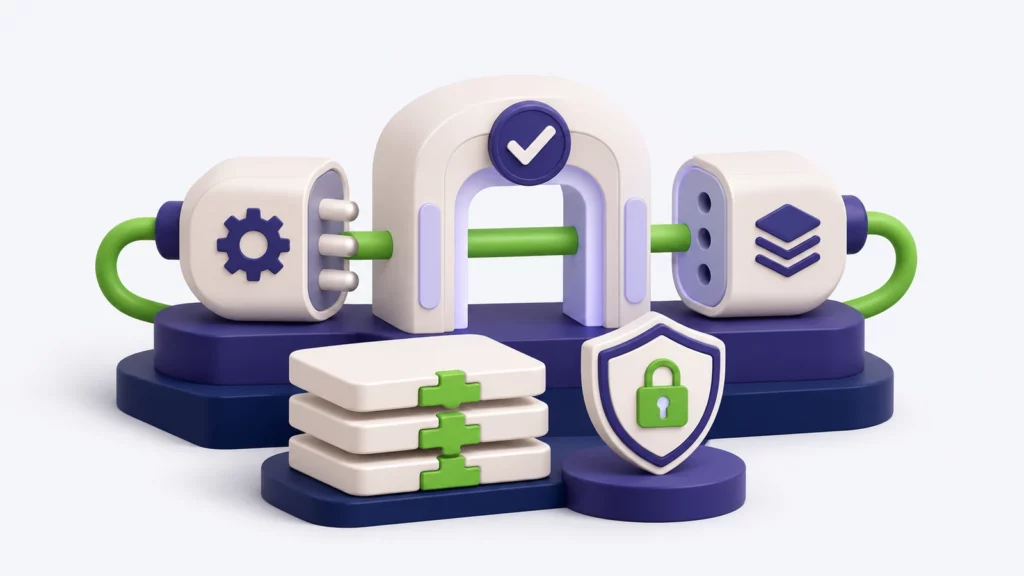
Well-scoped integrations allow assistants and applications to use specific business functions without broad, unnecessary access.
MCP and API integration covers the interface contract, permitted tools and operations, input and output validation, caller authorisation and test evidence. This is the connectivity layer for a website, app or assistant, not a substitute for building the product itself. We select the interface only after understanding its consumers and security boundaries.
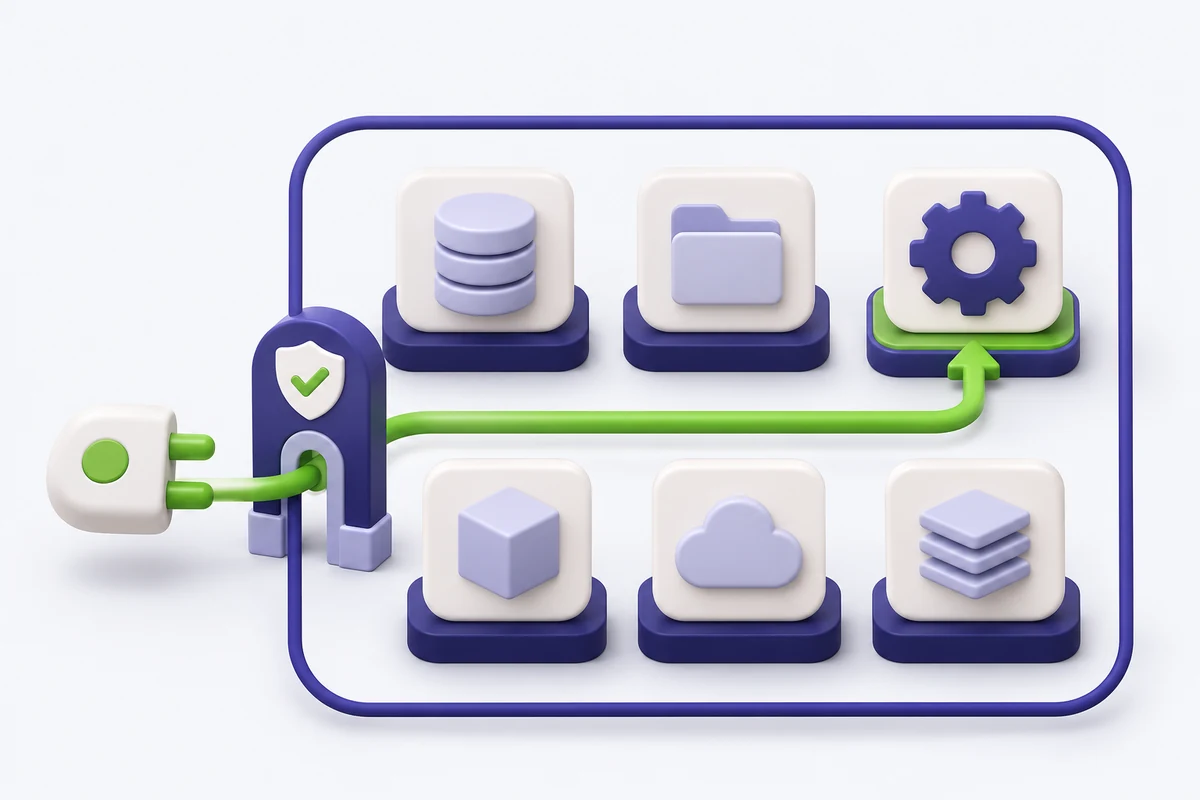
A concrete choice: a mobile API or an MCP tool?
A mobile app requesting its user’s assigned tasks typically benefits from a stable API endpoint with predictable response formats. An AI assistant that can find an authorised project report may benefit from a narrowly described tool interface. In both cases the source application must verify the caller’s permissions and ownership of the record. Tool descriptions and model instructions are not an access-control boundary.
Which integration layer is needed? First describe the consuming system and the exact operation it must perform: read a permitted record, create a follow-up, return an acknowledgement or reject unauthorised input. MCP is useful where a tool-aware assistant needs a controlled catalogue of actions; a conventional API can be enough for a deterministic application. Compare CRM integration when customer data ownership and synchronisation are the main risks, or workflow automation when a sequence of rules, retries and handoffs matters more than a new protocol. Define authentication, role scope, logs, failure handling and rollback as acceptance tests. An interface contract does not, on its own, establish that the connected assistant or application is production-ready.
The technical acceptance list includes malformed input, denied users, out-of-scope records, connection failures, action logs and credential revocation. The client receives maintainable interface documentation and safe examples without public disclosure of private data or secrets.
MCP implementation examples with different consumers
Our public work includes Management Intelligence integration through MCP and OAuth, and an MCP connection for reading and writing selected Rank Math SEO metadata in WordPress. They illustrate how management tools and editorial tools can expose different authorised operations. Authentication alone does not prove sound access control, and credentials or private client records should never be published as supporting evidence.
Decide whether MCP adds value beyond a conventional API
MCP is useful when an AI-driven client needs to discover and invoke a limited set of well-described tools. A mobile application or back-office integration may need a conventional API instead. We start by specifying the consumer, permitted operation, data contract and expected failure states rather than adding a protocol for its own sake.
Authentication confirms who is connecting, but authorisation must still restrict what that identity may read or change. Tool descriptions do not replace checks performed by the source system.
Testing access, errors and revocation
An acceptance matrix covers valid calls, unauthorised roles, records outside an employee’s ownership, malformed input, tool failures, cancellation and credential revocation. We document what requires human confirmation and which activity must be logged for audit purposes.
The delivery includes interface descriptions, safe examples and operational notes appropriate to the project, without publishing credentials or private client data.
When is MCP the right integration choice?
Connecting a web form to CRM when a customer submits it may require a simple webhook or API. Giving an assistant controlled access to several business functions can require a different approach to tool discovery and invocation. MCP can be useful in that second scenario, but it is not automatically the best solution for every system-to-system connection. We start by identifying the user, the intended action, the relevant data and the operational boundaries, then compare integration methods.
A read-only reporting tool has different implications from a tool that changes the state of a deal or creates a payment request. Before implementation, we write down which operations are permitted, which need confirmation and which must never be exposed to the assistant. That is a better starting point than choosing a protocol because it is new.
An interface contract should be understandable
An API might return a project ID while a manager actually needs the project name, responsible person and open tasks. Technical correctness is necessary but not enough for a useful result. We specify the fields, their meanings, allowed values, empty states and error responses in advance. This helps both developers and AI clients avoid guessing how to interpret an undocumented response.
Where data ownership is sensitive, we return only what the authorized role requires. Tests should cover missing values, unexpected inputs, large result sets and version changes. An integration that works only for the happy-path demo is not ready for daily operations.
Authentication does not replace authorization
OAuth can verify identity and establish a connection, but it does not mean the connected user has permission to read every team’s records. The server must check ownership and role permissions on every meaningful request. We test the same tool with different roles, including attempts to access records outside a user’s scope, and expect explicit rejection.
Tokens should be stored and rotated appropriately, and secrets should not appear in prompts, example responses or user-visible logs. For tools with side effects we decide whether human approval, an audit trail or a rollback procedure is required. A model’s instruction to be careful cannot enforce server security by itself.
Testing two layers of behavior
The server layer should validate input, return stable output formats and reject unauthorized operations. The assistant layer must select the appropriate tool, use it in the right context and explain results without inventing missing information. A passing API unit test does not prove that an agent will choose the right operation, and a successful assistant demonstration does not prove access control.
We build representative cases such as reading an open task, retrieving a summarized report and handling an unavailable tool. We include malicious or ambiguous instructions in testing where appropriate and ensure that the underlying authorization still holds. We document failures and improvements rather than hiding them behind a polished interface.
Choosing a sustainable deployment pattern
The solution may require a dedicated adapter, a conventional API gateway, or a limited set of service endpoints. We consider where credentials live, how the connection is monitored, who owns the server, and how changes in source data models affect consumers. Versioned contracts, staged releases and safe rollback help avoid disruptions to existing applications.
Scopious separates integration logic from unrelated production workflows where possible. If a mobile app depends on a stable API, changing the browser application to accommodate an assistant may introduce unnecessary risk. Clear boundaries make future maintenance and troubleshooting less expensive.
What Scopious will deliver
A scoped project can include a tool catalogue, input and output specifications, authorization review, integration implementation, negative test cases, monitoring and technical handover. The exact scope depends on source-system access and whether the required functions are already supported by official interfaces.
MCP and API integration provides controlled interfaces to an existing business system; it does not by itself design an AI assistant that understands enquiries or escalates ambiguous requests. For a complete assistant engagement, review the AI Agent development service and agree which functions need tool access.
We do not claim that every application is MCP-ready or that connection success proves secure operation. The project succeeds when the right authorized user can reliably perform an agreed action, while an unauthorized request is stopped and recorded appropriately.
Relevant documented work: Scopious lists an OAuth-connected MCP integration for Management Intelligence and a Rank Math MCP integration used to read and update WordPress SEO metadata. These describe integration boundaries and technical capabilities, rather than an implied security certification or performance result. Review the documented MCP and systems projects and agree exactly which tools and permissions a new consumer requires.
For the Arabic version of this service: النسخة العربية.
SCOPIOUS / NEXT STEP
Start with your business need
Share the current setup and what you want to improve. We can discuss a clear scope and reviewable next steps.