
SCOPIOUS / AI AGENTS
AI Agent Development for Businesses
Business AI agent development with approved knowledge, controlled tool access, human escalation, permission checks and repeatable acceptance testing.
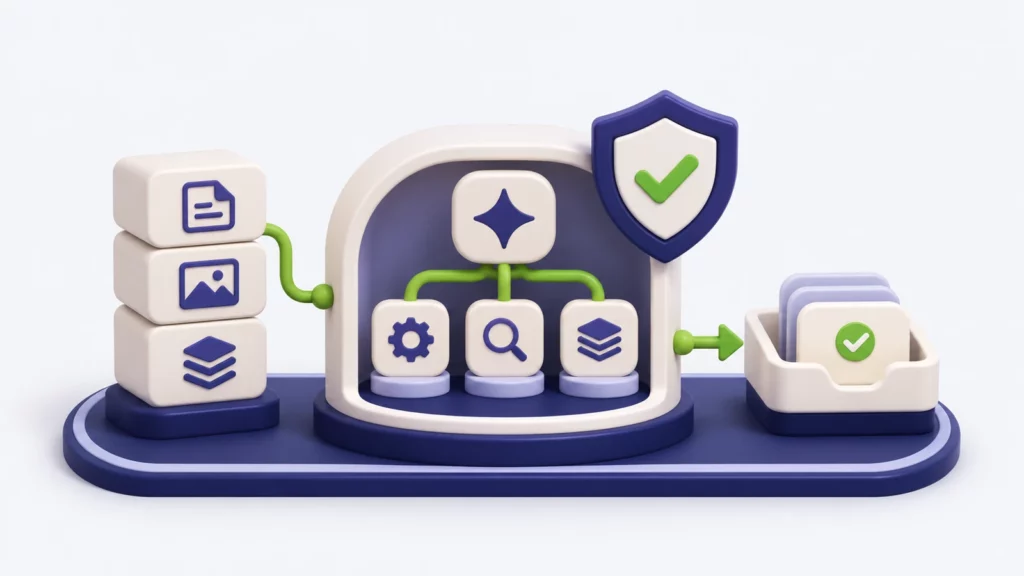
A business assistant needs approved knowledge, explicit tool access and a reliable way to involve a person when necessary.
An AI Agent project begins by defining permitted questions and actions, approved knowledge sources, role boundaries and human escalation. The delivery scope can include a testable assistant, approved integrations, an evaluation set and maintenance documentation. Tool permissions and source-system controls must be tested before production use.
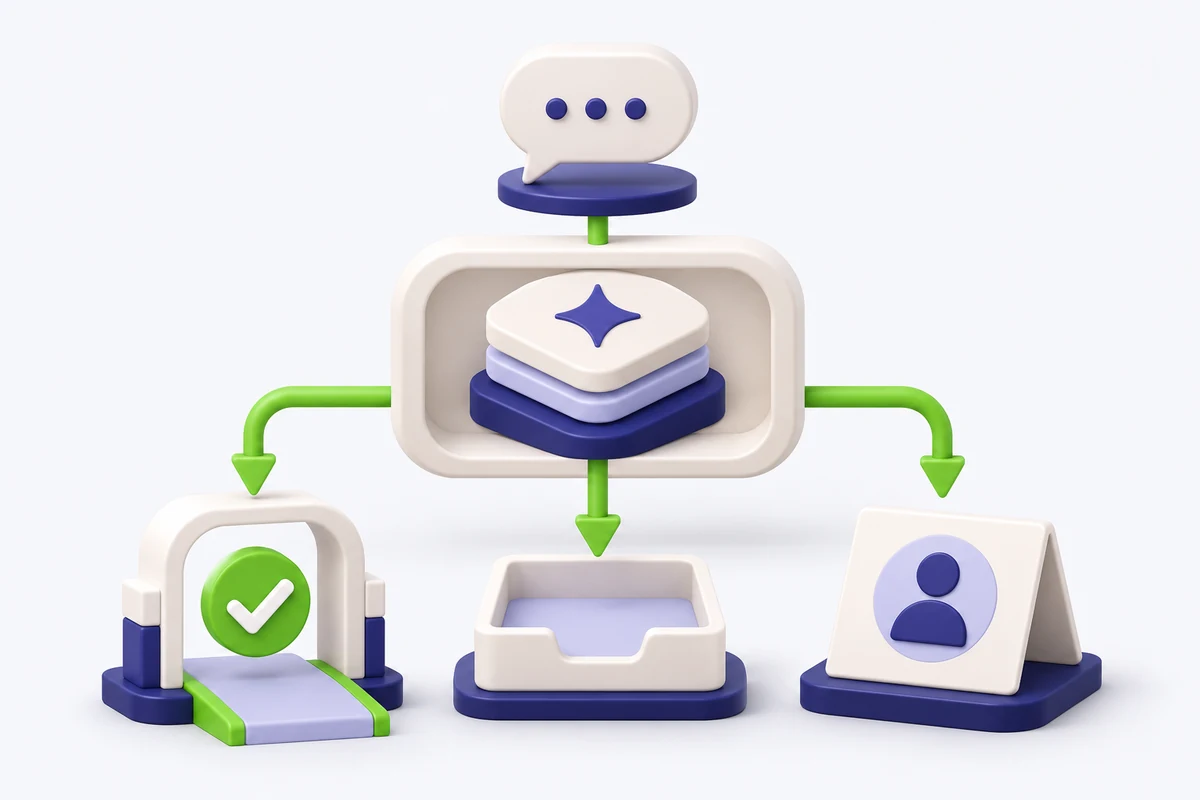
Three cases every business AI agent should be tested against
First, the user asks a question absent from the approved knowledge base; the agent should not invent an answer. Second, a staff member requests information belonging to another team; access checks must be enforced by the source system, not just instructions to the model. Third, an external tool times out while creating a request; retry behaviour should avoid duplicate actions and explain whether the transaction was completed.
When an AI agent is the right choice: a basic chatbot can answer well-defined questions, while an agent may use approved tools to retrieve records, create a permitted task or hand an uncertain request to a person. The buying decision should start with three acceptance checks: which information it may read, which actions it may take, and which situations require human review. For predictable triggers and repeatable handoffs, compare the workflow automation service. When customer records and ownership are part of the solution, define those requirements through CRM integration. Tool access, audit logs and escalation should be tested before an assistant is released; conversational fluency is not proof that an action is safe.
A reliable engagement defines approved sources, ownership of those sources, permission tests, escalation rules and documented outcomes on a relevant test set. A polished demo should never be described as evidence of production-wide accuracy or financial returns.
Business assistant examples described in our portfolio
The selected-work gallery describes Ghaith, an internal assistant for work and project context, a customer-service assistant for understanding and routing enquiries, and a natural-language CRM command assistant. These address different responsibilities and data boundaries. We do not generalise from one system to an assurance that another agent will always be accurate. Permissions, source quality and escalation must be tested for the new scope.
Identify the decision that an agent is allowed to support
A support assistant may answer from approved public information and hand an unusual case to a person. An internal agent may retrieve selected operational records, but the underlying system must verify each user’s access independently. We define the person, decision, knowledge source and permitted tools before selecting the model or automation platform.
A business does not always need an autonomous agent. In some cases, a searchable knowledge base or a deterministic workflow is more dependable, easier to review and cheaper to maintain.
Acceptance tests for an operational assistant
We test supported answers, missing knowledge, conflicting sources, unsafe requests, denied permissions, tool failures and escalation to a human. The handover identifies who maintains the knowledge, how authorisations are revoked and how actions are audited.
A useful demonstration is not proof of broad reliability or commercial growth. Claims about quality should be tied to a documented test set rather than an attractive conversation screenshot.
The question an AI assistant must sometimes refuse
A customer asks an assistant for an invoice that belongs to another account. Even if the language model can understand the request and a connected tool could retrieve the data, the correct response is not to comply. Business AI must respect who is asking, what they can access, and what can be done without human review. We begin assistant development by identifying allowed questions and actions, not by claiming it can answer anything.
A customer-facing chatbot may only need to explain services, collect a scoped enquiry and hand off unusual requests. An internal agent may retrieve project tasks or generate a report under the employee’s actual permissions. These are different use cases with different risks. A more autonomous label does not automatically make a solution more valuable.
Knowledge that the team can maintain
Reliable answers start with approved sources. Public service information, internal policy documents, product specifications and operational records may all be relevant, but they should not be mixed without access boundaries. We specify which source owns each fact, when it was updated and who can approve corrections. If two versions conflict, the assistant should not choose one simply because its wording sounds more confident.
We test realistic questions that include incomplete details, ambiguous language and requests beyond the available knowledge. A useful assistant can explain a limitation or route the user to a person. Hallucinating a price or policy is worse than admitting the information is not available, especially when customers may make purchasing decisions based on the answer.
Agents use tools; tools need independent authorization
A tool call may retrieve a task, create a reminder or update a deal. Each operation requires a documented contract and server-side authorization based on the authenticated user and record. A model instruction to respect permissions is not a replacement for those checks. We test attempts to access another team’s data and verify that the backend rejects them even if the assistant constructs a plausible request.
Sensitive changes may require confirmation, an audit log and a rollback path. We keep API secrets outside prompt text, minimize personal information in logs and review how an integration is revoked if an employee leaves. Security must be designed into the workflow rather than added to the sales pitch.
Designing the conversation around the next useful action
Suppose a prospect arrives after reading a CRM integration guide. A suitable assistant asks what system they use, what needs to connect, and whether there is an existing interface or process description. It should not demand a large list of private records in a public chat. Once it has enough context, it can summarize the request for the correct team or provide a route to the relevant service page.
An escalation is only helpful if the employee receives the actual problem, the service category and the information the customer agreed to share. We map failures as carefully as successful responses: unanswered questions, unavailable tools, abandoned conversations and duplicate leads should have explicit handling.
Testing and measurement
We test knowledge accuracy, permission boundaries, inappropriate requests, tool errors, language handling and human handoffs before expanding use. If the assistant supports Arabic and English, both languages need representative cases rather than assuming one set of answers covers the other. We also observe response time and operating cost under realistic loads, not just a demonstration of a few scripted messages.
The right metric depends on the job. A support bot may be judged by accurate routing and resolution; an internal agent by time saved and reliable access to permitted tasks. Chat volume alone does not prove customer growth. Reviews should include examples of failures and what was changed to address them.
Delivery and ownership
The final scope should list connected sources and tools, roles, test cases, handoff rules, maintenance responsibilities and the ability to pause or revoke access. Clients should be able to update approved content without recreating the entire system. We document important assumptions, including integrations that depend on third-party APIs or existing server permissions.
An AI agent needs a safe boundary between conversation and any permitted business action. When the project requires tool calls, scoped access and traceable permissions, the MCP and API integration service covers the connection layer separately from knowledge design, user experience and agent testing.
Scopious can support conversational interfaces, automation and systems integration, but any public case study must accurately describe the work delivered and must not disclose client data. We prefer an explained implementation boundary to unsupported promises of fully autonomous operations.
Relevant documented work: the Scopious portfolio includes Ghaith — Internal AI Assistant, a customer-service assistant for routing requests, and CRM natural-language command workflows with permission checks. These examples show the kinds of assistant and integration scopes described here, not independently verified productivity or sales gains. Review the published AI assistant projects and their stated scope before discussing what functions your organisation would authorise.
For the Arabic version of this service: النسخة العربية.
SCOPIOUS / NEXT STEP
Start with your business need
Share the current setup and what you want to improve. We can discuss a clear scope and reviewable next steps.