
SCOPIOUS / GTM ENGINEERING
GTM Engineering Services for B2B Growth
B2B GTM Engineering services: define ideal customer profiles, discover and verify companies, qualify opportunities and hand leads to CRM.

Useful GTM work begins with an ideal customer profile and evidence for why each opportunity is relevant.
GTM Engineering starts with an agreed ideal customer profile, target market and qualification exclusions. Discovery and verification results are reviewed against evidence and delivered to sales with clear reasons for acceptance. A discovered company is not automatically a qualified opportunity, and fixed meeting or sales volumes are not promised.
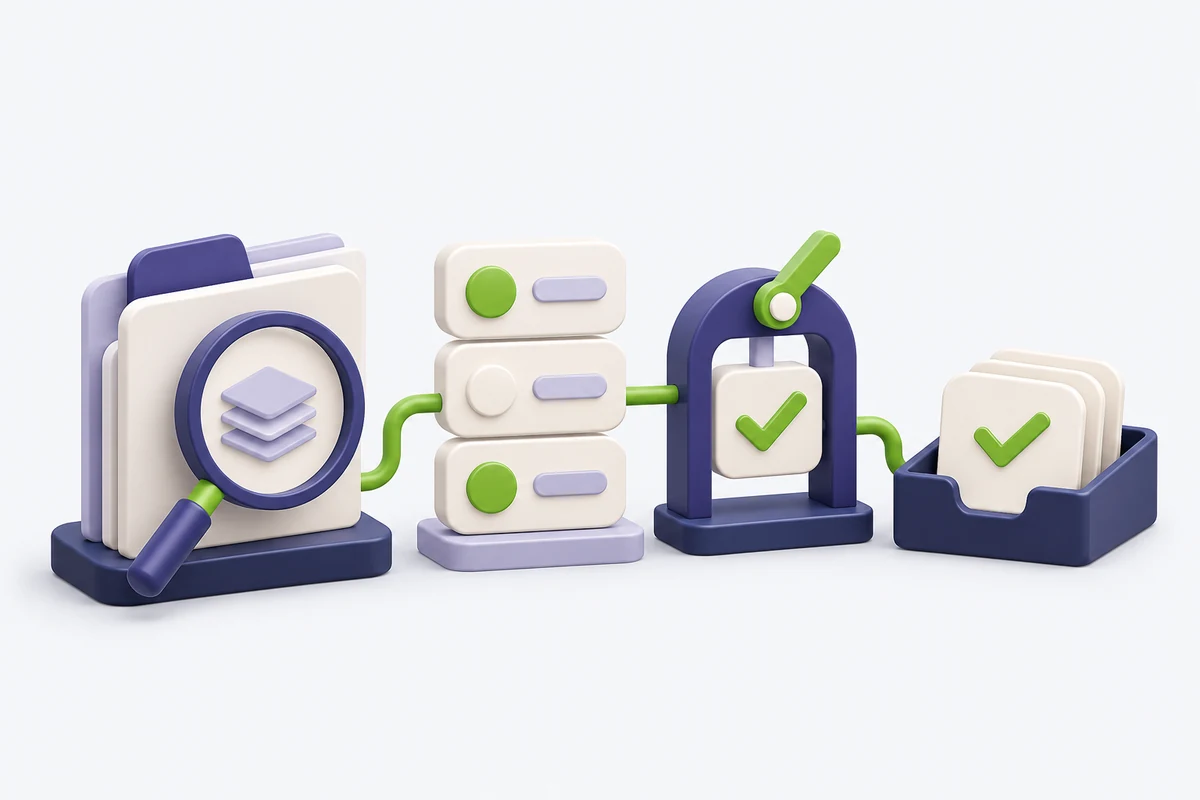
Why a prospect can be in the right industry and still fail the ICP
A business directory might classify a company as a contractor although its activities are primarily wholesale supplies. Sending that record to a project-services sales team simply because the industry label matches creates noise. An effective ideal customer profile defines the offer, market boundaries, firmographic evidence and explicit rejection rules. Every accepted company should have a reviewable reason for its classification.
From discovery to a qualified opportunity: start with an ideal customer profile, exclusion rules and clear evidence for why each company could fit the offer. Record source, market, verification date, company attributes and the reason a prospect is accepted or rejected. Only validated records should enter the pipeline, with a named owner and a next action. For the handoff and source-of-truth rules, see CRM integration; for controlled reminders and status transitions, see workflow automation. Business discovery and data qualification are documented among our selected projects, but the number of discovered records is not the same as sales-qualified opportunities or closed deals. The acceptance criteria must distinguish those stages.
Reporting distinguishes companies discovered from those verified, qualified and accepted by sales. We do not equate a large list with revenue or promise a fixed meeting rate. Data sources and permission to use them must be reviewed before enrichment or automation begins.
How Scopious OS relates to documented GTM work
The selected-work gallery lists a Business Discovery & Data Qualification workflow and a Gemini-assisted AI Business Discovery Planner within Scopious OS. These provide examples of discovery planning, record checks and qualification workflows. The records do not substantiate a fixed number of meetings or closed deals, so we use them to explain the method and its operational limits rather than invent sales outcomes.
A target-company list becomes useful only after qualification
A working ICP should describe market, business fit, buying signals, exclusions and the evidence behind each classification. Discovery results must then be verified and deduplicated before sales receives them. A name found in a directory is not automatically an eligible lead or a sales opportunity.
The design includes compliant data sources, a review stage and a traceable reason for each handoff. Sales should be able to accept, reject or request clarification without guessing why the record was selected.
Define the handoff and the measurement before the pipeline grows
The outputs can include ICP criteria, source rules, enrichment limits, qualification fields, CRM mapping, review procedures and stage definitions. We distinguish companies discovered, companies qualified, records accepted by sales and opportunities progressed.
Scopious OS may illustrate an internal discovery and routing approach where suitable, but case material should not claim conversion or revenue outcomes that have not been measured and approved for publication.
A longer prospect list is not the same as a stronger pipeline
A company can collect thousands of business names and still struggle to create meaningful sales conversations. Why? Some records do not fit the service, others are duplicated or outdated, and the sales team cannot see why a prospect was selected. GTM Engineering starts by connecting the definition of a suitable customer to evidence, qualification and an accountable next action. It is a process for improving decisions, not simply a data collection exercise.
We ask what makes a company commercially relevant: industry, operating location, size, existing processes, plausible needs and reasons for exclusion. Those attributes are translated into a reviewable ideal customer profile rather than vague descriptions such as any growing business. The profile should be precise enough for a team to challenge and update.
A usable ICP is built with sales, not in isolation
Marketing may define an audience based on broad categories, while sales knows which deals stall because of budget, systems or decision-making complexity. We bring those perspectives together and distinguish mandatory fit criteria from helpful signals. A business may match the industry but operate in a region the company does not serve. That should be visible before anyone spends time on outreach.
We document the version of the ICP and its assumptions. When the focus changes, the team should be able to explain which records need requalification rather than silently assigning new scores that appear authoritative. An ICP is a maintained business decision, not a one-off document.
Discovery, verification and data provenance
Research tools may return company names, industries, locations and public descriptions. Not every field is equally reliable, and availability does not imply unrestricted reuse. We choose approved sources, preserve references and dates, and separate observed facts from automated classification or inference. Where information is uncertain, the record should show that it needs verification.
AI can help summarize and classify company descriptions, but it must not invent phone numbers, people or evidence of purchase intent. We review deduplication and the right level of personal-data processing before passing records into another system. The aim is a trustworthy record an employee can use, not a convincingly formatted list.
The handoff to CRM is part of GTM
A qualified opportunity needs an identity, reason for fit, evidence, ownership and a next step. If a spreadsheet is delivered without these elements, the sales team may repeat research or contact the wrong businesses. We define which status means identified, reviewed, accepted, disqualified or contacted, and how those transitions appear in CRM. Duplicate prevention and access permissions belong in this workflow.
Automated alerts can be useful once responsibilities are clear. They should not become indiscriminate messaging. Outreach must respect applicable policies, data permissions and brand reputation. We usually recommend starting with a reviewable volume that matches sales capacity rather than optimizing only for the largest number of leads discovered.
Measurement is about acceptance and progress
The first useful metrics are record completeness, duplicate rate, evidence quality and the proportion of discovered companies accepted by sales. Later measures can examine qualified conversations, proposals and outcomes when the tracking process is reliable. A database of twenty thousand names is not equivalent to twenty thousand potential customers, and it does not guarantee a particular number of meetings.
We retain the difference between a source-provided fact, a model-generated suggestion and a human-confirmed result. This makes it possible to identify where qualification breaks down and adjust the process rather than blaming individual team members for poor data.
Project scope and deliverables
An engagement can include ICP design, source and compliance review, discovery criteria, qualification rules, deduplication, CRM data mapping, a pilot run and quality reporting. Integrations or AI classification are specified as components of that process, not sold as proof of guaranteed demand.
Scopious combines marketing and systems work, so the important handoff is from an understandable value proposition to a recorded and actionable opportunity. We define success through accepted work and measured learning, and expand the process only when the pilot supports that decision.
Relevant documented work: the portfolio includes Business Discovery & Data Qualification, covering discovery, enrichment, lead verification and pipeline handoff. It describes a process and deliverables; it does not substantiate a guaranteed meeting volume, conversion rate or number of sales. Review the published business-discovery scope and define qualification criteria, permitted sources and acceptance evidence for your market.
For the Arabic version of this service: النسخة العربية.
SCOPIOUS / NEXT STEP
Start with your business need
Share the current setup and what you want to improve. We can discuss a clear scope and reviewable next steps.