Marketing Company Ads: Planning, Budgeting and Measurement
Choosing a marketing company to manage advertising should begin with a clear business brief, not a promise of immediate results. Specify the audience, offer, geography, available budget and the action that matters after someone sees or clicks an ad. This guide compares the roles of search and social advertising, explains the controls an agency should document and outlines how to evaluate lead quality alongside campaign metrics. The aim is to help businesses assess a proposed approach before committing spend.
With today’s competitive digital landscape, one thing is for sure: businesses need to stand out to enable their target audience to take notice. This is where our experts come into play.
Marketing company Ads in Google AdWords
Being a partner with a Scopious Marketing company Ads in Google AdWords powers several ways in which the power of Google Ads drives your website for targeted traffic and lead generation.
Before appointing an advertising partner, request a practical account structure, a description of the approval process and a sample reporting format with sensitive client information removed. Ask who can access billing, who owns the ad assets and how unsuccessful tests will be identified and stopped. An illustrative example: if two campaigns report the same number of enquiries but one produces more irrelevant contacts, the review should consider lead qualification rather than simply praising the higher click-through rate. Any claim about a provider’s previous results should be supported by verifiable evidence.

Our Services of Google Ads:
- Creation and Controls of Campaigns: We create and manage Google AdWords campaigns tailored to your needs and target audience.
- Keyword Research: We identify the relevant keywords that will make the potential customers reach your ads.
- Ad Copywriting: We have skilled copywriters who will help in the creation of compelling ad copies that assure good clicks and conversions.
- Bid Optimization: We monitor your bid continuously and optimize it for the ultimate return on investment.
- Performance Tracking and Analysis: We also develop comprehensive reports and analyze the performance of your campaigns to offer advice based on data analysis.
Why Choose Scopious Marketing Agency for Your Google Ads:
- Proven Success: We have designed successful Google Ads campaigns across businesses of all sizes.
- Expertise and Experience: We deeply understand Google Ads, and best practices, and stay up to speed with all the latest developments.
- Customized Approach: We customize our strategies to achieve results tailored to your unique business objectives.
Transparent Communication: We keep you in the loop as regards what is happening along the lines of the campaign process and performance.
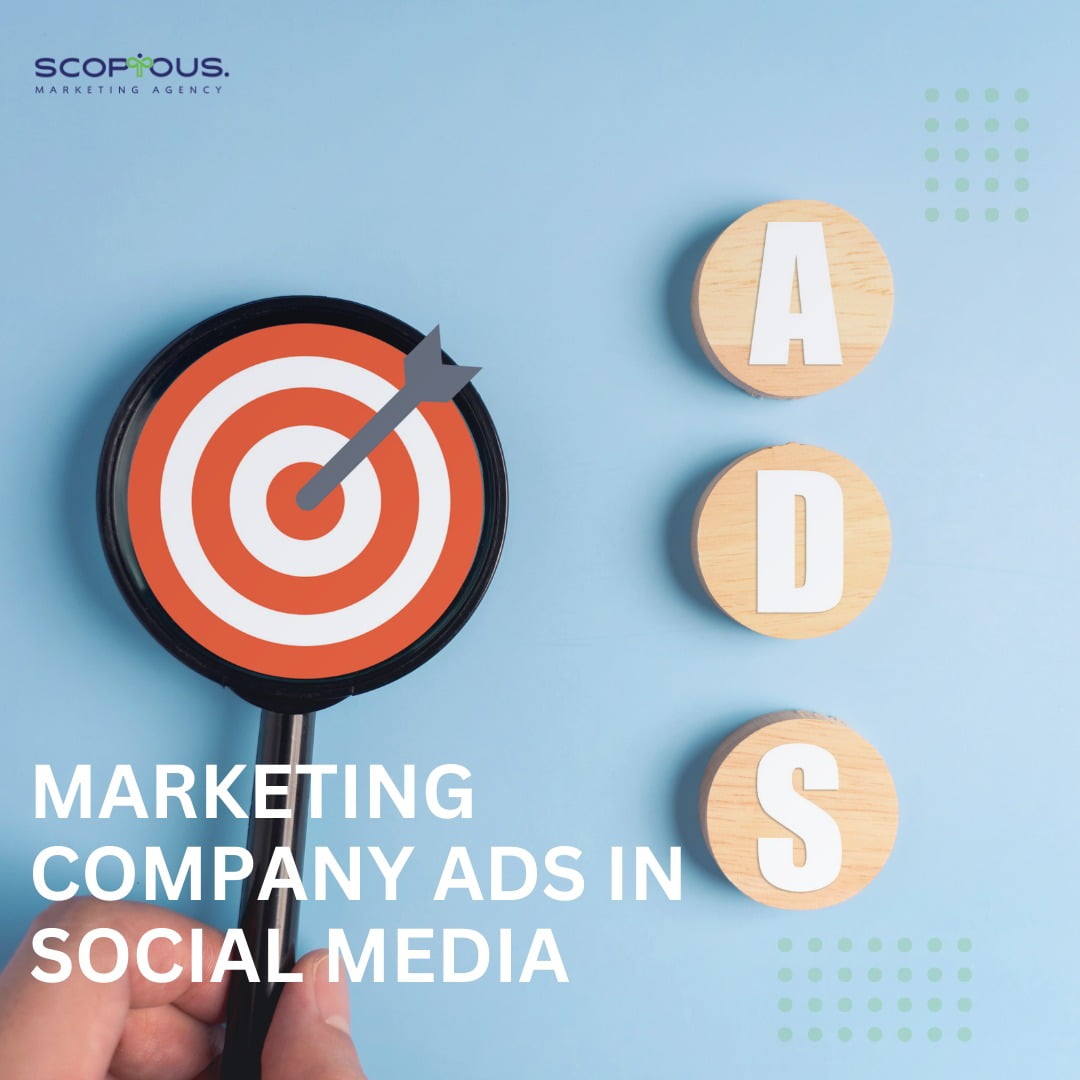
Marketing company Ads in Social Media
At Scopious Marketing Agency, we keep in mind that in today’s world, a formidable social media presence is not only crucial but highly relevant. Our experts will guide you in unleashing your potential on all the social media platforms for reaching your target audience, creating brand awareness, and driving engagement.

Our Social Media Marketing Services:
- Social Media Strategy Development: We develop fitted social media strategies to respond to the needs of your business and target audience.
- Content Creation: Through engaging and shareable content, our accomplished content creators speak to your audience on your behalf.
- Community Management: We will manage social media communities for you, responding to comments and messages and usher positive engagement itself.
- Social Media Advertising: We run targeted social media ad campaigns targeting certain demographics and driving conversions.
- Analytics and Reporting: We monitor your key performance indicators and provide regular reports on the effectiveness of your social media campaign.
Why choose Scopious Marketing Agency for your social media marketing?
- Expertise and Experience: Our team has broad knowledge in diverse social media platforms and their respective best practices.
- Results-Oriented Approach: We focus on ensuring that all our deliveries are measurable in terms of contribution to your business growth.
- Personalized Service: We work closely with our clients to understand their special needs and provide personalized solutions.
- Stay Current: We highly stay updated with current happenings about social media and algorithmic changes.
Marketing company Ads with writing Content
At the Scopious Marketing company Ads with Writing Content, we look at high-quality content as the basis for any successful marketing. Our team will support you in developing compelling content with great writers and engaging in content creation that attracts, engages, and converts your target audience.

Our Content Marketing Services:
- Content Strategy Development: We develop a content strategy in tandem with the client to meet the desired business objectives and target audience.
- Content Creation: Engaging blog posts, articles, whitepapers, case studies, and more are what our writers do best.
- Keyword Optimization: We optimize your content for search engines to improve visibility and attract organic traffic.
- Distribution of Content: We distribute your content through our channels to reach the relevant target audience identified, whether it be through social media, email marketing, or online directories.
- Analytics and Measurement: Tracking of key metrics to measure the performance of your content to make data-driven adjustments.
Why Choose Scopious Marketing Agency for Your Content Marketing:
- Our Team of Expert Writers: We have talented writers in our team, who have a strong interest in creating riveting stories.
- Industry Experience: We have experience in several industries and are capable of generating content that would appeal to your target audience.
- Data-driven approach: We inform our content strategy with analytics to have the most significant effect.
- SEO Optimization: We’ll optimize your content for search engines to drive organic traffic.
Marketing company Ads and responsible advertising budgets
At the Scopious Marketing company Ads and advertising plans at the lowest cost, we don’t believe that effective marketing necessarily needs too much money. We will meet your needs in the best possible manner with variably effective and affordable marketing services.

Our Budget-Friendly Marketing Plans:
- Customized Marketing Packages: We design customized marketing packages to fit your budget and deliver measurable results.
- Pricing and performance expectations: Agree in writing on management fees, media spend, deliverables and how results will be evaluated.
- Economical Social Media Marketing: Our social media marketing plans offer great returns on investment.
- Cost-Effective SEO Services: We are here with our pocket-friendly SEO services, which will help you boost your ranking in search engine rankings and attract organic traffic.
- Budget-friendly Content Marketing: Our content marketing services facilitate you in generating high-quality content at affordable prices.
Why Choose Scopious Marketing Agency for Affordable Marketing:
- Transparent Pricing: We have a no-hidden-cost pricing methodology.
- Measurable Results: The focus is to deliver results that ensure value for your money.
- Flexible Options: We have different types of marketing services and packages at affordable prices to suit your budget.
- Experienced Team: Our team has experience in creating effective marketing campaigns at a competitive price.
What an advertising partner should clarify first
A marketing company should not start by choosing an ad platform or promising cheap clicks. Begin with the commercial objective: product sales, qualified enquiries, appointments, event registrations or repeat purchases. Identify who can become a customer, what action they should take and how the business will handle the response. A campaign for a high-consideration B2B service needs different messaging and follow-up from a local retail promotion. Ask the team to define the offer, audience, geographic scope, exclusions and measurement plan before any budget is spent. Establish the decision maker for copy, creative, landing-page changes and lead handling. If the website has no reliable conversion event or the sales team cannot respond quickly, address those gaps first. Advertising can create opportunities to be considered, but it cannot repair an unclear product proposition or guarantee revenue. A written brief helps everyone judge performance against the same objective rather than whichever metric looks most impressive at the end of the month.
Search ads versus social ads: match the customer journey
Search advertising is often useful when people are actively looking for a specific solution, such as a service near them or a product with clear specifications. Social advertising can introduce an offer to people who are not searching for it yet, or bring previous visitors back to a relevant page. Neither channel is automatically superior. Examine the query or audience intent, purchase cycle, creative resources and landing-page experience before allocating spend. Search campaigns need thoughtful keyword groups, negative terms and ads that reflect the user’s question. Social campaigns need distinctive creative, suitable audience signals and a message that makes sense without a prior search. When comparing approaches, the SEO versus Google Ads decision guide (Arabic) explains how paid demand and longer-term organic visibility can support different business needs. Start with a testable hypothesis and a limited budget, then use observed lead quality to inform expansion rather than assuming more impressions will create more sales.
Build a Google Ads account for clarity
Structure search campaigns around closely related services and meaningful geographic or business differences, not dozens of nearly identical ad groups. Separate brand searches from non-brand demand so results do not overstate new customer acquisition. Review match types, search terms and negative keywords regularly; an apparently low cost per click is unhelpful if the query attracts students, job seekers or suppliers rather than customers. Write advertisements that describe a real benefit, set a credible expectation and lead to a page that delivers the promised information. Use conversion actions that represent meaningful behaviour, such as a submitted qualified enquiry, instead of counting every page view as success. Protect access by keeping account ownership and billing clear. Changes to bidding, targeting or attribution should be documented with dates so performance shifts can be interpreted. Our Google Ads campaign guide provides additional planning context without implying that any particular bidding strategy is right for every account.
Use landing pages to reduce wasted spend
A campaign landing page should answer the question created by the ad immediately. Visitors need to see what is offered, where it is available, who it suits and how to take the next step. Remove unnecessary friction from forms, but keep enough information to qualify enquiries. For a complex service, a short explanation of scope and process may be more useful than a large generic form. Check the mobile experience, loading behaviour, readability and whether the call to action works across common devices. Make sure the form or booking route sends data to the right team and that consent language matches actual data handling. A campaign with strong click-through rate and weak lead quality may need a different landing-page promise rather than a higher bid. Run one meaningful test at a time where possible, document the outcome and avoid declaring a winner from tiny samples. Landing-page improvement is part of advertising operations, not an optional design afterthought.
Plan social creative as a learning system
Social platforms reward relevant messages presented in formats people can understand quickly, but creative fatigue and audience overlap can make early results unstable. Prepare several genuinely different concepts: a practical demonstration, a common customer question, an explanation of the process and a clear comparison of options. Each concept should have an identifiable audience and offer. Avoid manufacturing testimonials, before-and-after results or urgency that the business cannot substantiate. Use captions, accessible text and visual consistency, and check that images or videos are licensed for the intended placement. Review comments and enquiries for repeated misunderstandings; they often reveal more about the offer than a surface engagement metric. Distinguish organic community management from paid campaign management in the scope of work. If the company also needs a coordinated editorial plan, our SEO and social media service guide discusses how channels can share useful content without duplicating the same message everywhere.
Budget allocation and the real cost of a lead
A practical budget includes media spend, management time, creative production, landing-page work, tracking and sales follow-up. The cheapest management fee is not necessarily the lowest total cost. Ask for a breakdown of what the agency controls and which costs are paid directly to platforms or other vendors. Define a test period that allows enough observations to make a decision, but set loss limits so poor performance is not allowed to continue indefinitely. Cost per lead is only an intermediate metric: track whether enquiries are relevant, contacted promptly and progressed to opportunities. A campaign that generates fewer qualified leads may outperform one producing a large volume of unsuitable forms. Where the sales cycle is long, use interim indicators cautiously and explain their limitations. Avoid presenting hypothetical returns as guaranteed outcomes. Agree how unused budget, changes in spend and new creative requests are approved before the campaign begins.
Set up measurement without overstating precision
Conversion tracking should be designed around the real customer journey and tested before launch. Check that form submissions, calls, purchases or booking completions are recorded once, and that test events do not inflate reports. Different platforms use different attribution windows and may each claim credit for the same sale; totals should not simply be added together. Use first-party records and CRM outcomes where possible to distinguish leads from customers, with appropriate privacy safeguards. Report reach and clicks for context, but connect the discussion to lead quality, cost and operational capacity. Document the attribution model, important filters and any periods when tracking was broken. If offline sales are substantial, agree a practical way to reconcile campaign enquiries with sales outcomes without exposing unnecessary personal information. An honest report states where measurement is incomplete instead of hiding uncertainty behind a single return-on-ad-spend figure.
Review campaigns on a disciplined schedule
Daily monitoring should catch broken links, rejected ads, unusual spend and urgent lead-handling issues. Weekly reviews can examine search terms, creative performance, placement quality, frequency and landing-page friction. Monthly reviews should assess whether the original business hypothesis is still supported and whether budgets or channels need adjustment. Avoid making major changes to several variables at once, because it becomes difficult to identify what caused an improvement or decline. Record each material adjustment, its reason and the expected effect. Consider seasonality, stock availability, holidays and competitor activity when interpreting changes. A campaign that looks weak after two days may not have enough data, while a campaign with repeated irrelevant leads should not wait a month for action. Ask the agency to show both work completed and decisions proposed. The purpose of optimisation is to learn and allocate resources responsibly, not to create an endless stream of cosmetic changes.
Build a budget release gate before increasing spend
Agree on who can approve a new campaign, a change in daily budget or a move between channels before the agency begins. Put the approval limit in writing, together with the contact who can respond when a campaign is spending but the destination form stops working. A platform budget cap and an agency fee are different commitments, so the reporting document should show both clearly. If the business has several service areas, treat the cost of serving a new customer in each area as part of the decision instead of dividing budget evenly by geography.
Start with the smallest experiment that can answer a meaningful question. Record the hypothesis, target customer, offer, landing page, expected evidence and stop condition. Spend alone is not a reliable learning measure: a low-volume service may need more observation to understand customer fit, while a broken landing page should trigger immediate repair regardless of how little has been spent. Review whether the account is correctly tracking a validated request before increasing investment.
Use a unit-economics check without invented benchmarks
Before setting a target cost per qualified lead, ask the business to describe what an eligible request is worth under its own pricing and fulfillment conditions. A retail order with a predictable margin and a B2B quotation that takes months to close should not be assessed using the same generic target. Include sales follow-up capacity, expected cancellation or rejection reasons and the cost of delivering the product or service. When those figures are unknown, label the target provisional and avoid claiming an exact return on advertising investment.
Keep media delivery metrics separate from commercial quality metrics in the report. An ad can attract many clicks while generating requests from locations the business cannot serve. Conversely, a campaign with fewer clicks may produce more relevant discussions. Give the sales team a simple way to mark a request as qualified, unqualified or unresolved, then review samples without exporting unnecessary personal information. This makes discussions about budget decisions more useful than reporting cost per click alone.
Detect measurement faults before they become budget decisions
Set a short pre-launch test for every conversion action: complete a valid inquiry, confirm the visitor sees the expected message, verify the event is recorded once, and check that the responsible team receives it. Repeat the test after a form, analytics tag, consent setting or landing-page component changes. If a dashboard suddenly reports zero conversions, inspect the implementation and operational records before assuming customers stopped buying. A tracking failure and a demand problem require very different responses.
Document the limits of attribution. Someone may research through organic search, encounter an advertisement later and then contact the company directly. Platform reports use their own windows and rules; they should not be combined into a made-up count of unique people. Use consent-aware event definitions and explain which channels have incomplete information. When evidence is conflicting, pause a major budget reallocation until the team understands whether the discrepancy is in demand, response handling or measurement.
Prepare an account handover and escalation checklist
Ask the advertising partner to keep a current inventory of campaign accounts, billing ownership, domains, conversion definitions, approved creative files and access permissions. The client should have appropriate administrative access without distributing personal passwords. Record which changes require business approval, how emergency pauses work and who handles policy disapprovals or unexpected overspending. For a new vendor, the first deliverable may be a reliable inventory and cleanup plan rather than another campaign launched before anyone understands the existing system.
At the end of the engagement, request the decisions and lessons behind the figures: what was tested, which audience was excluded, which landing pages changed, what remains unmeasured and which campaign is safe to continue. The handover should preserve useful work without promising that past performance will repeat. A well-scoped arrangement reduces dependence on a single supplier and gives the business a practical basis for the next budget decision.
What to ask before hiring a marketing company for ads
Request a campaign plan with clear deliverables: research, account structure, creative quantities, landing-page responsibilities, tracking setup, reporting frequency and who owns each account. Ask how the team will handle disapproved ads, inaccurate leads, budget overruns and requests to pause activity. Clarify whether media spend is included in the quote and whether there are separate production or software charges. Review how the agency distinguishes brand demand from genuinely new prospects and how it reports sales outcomes. A good partner should be able to explain a recent decision process without relying on confidential client data or unsupported success claims. Check that access can be transferred if the engagement ends. For additional context about how advertising work fits into broader services, see our digital ads planning guide. Compare proposals against the same requirements instead of selecting solely by promised impressions or the lowest headline fee.
Contact Us
To discuss services relevant to your business and request a clear scope of work, visit our contact page.
For a defined campaign scope rather than a generic agency comparison, review our Google Ads management service. A useful agreement should distinguish campaign setup, tracking verification, performance review and the decisions that remain with the client.


No comment