SEO vs Google Ads: Which Should an Egyptian Business Choose?
An Egyptian business deciding between organic search and paid search is really deciding how quickly it needs to test demand, how it will qualify inquiries, and what it can maintain over time. Consider a hypothetical engineering-services company: its sales manager wants inquiries soon, while its finance manager wants to reduce dependence on monthly ad spend. Neither objective makes one channel universally superior. A useful decision starts with the buyer, the offer, and the conversion process—not a promise about rankings or clicks.
The fundamental difference
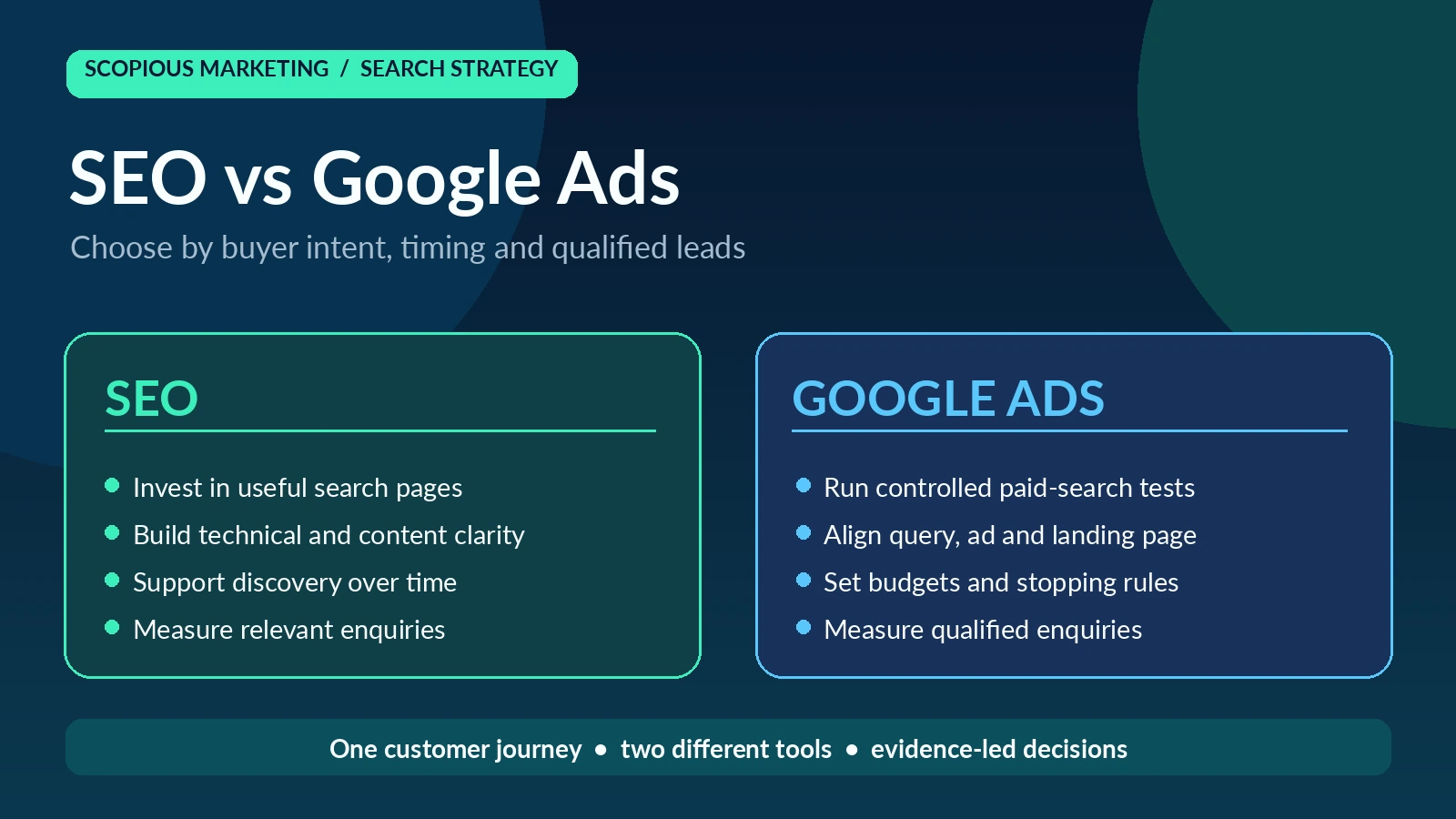
Search engine optimization improves a site’s discoverability, accessibility, usefulness and relevance for searches that matter to its customers. Organic clicks are not charged per click, but producing and maintaining useful pages, technical fixes and measurement requires investment. Rankings can change; no agency owns a permanent position. Google Ads, by contrast, lets an advertiser bid for placements under campaign and auction conditions, set budgets and test messages. Its traffic generally depends on campaigns continuing to run. Paying more cannot repair an unclear offer or a broken inquiry form. Neither channel guarantees qualified leads or sales.
Define a qualified lead before choosing a channel
A form submission is not necessarily a commercial opportunity. For a manufacturer supplying factories in Egypt, qualification might require the industry, location, required equipment and project timeframe. For B2B software, it might involve business size, current workflow and decision-making stage. Agree with sales on the information required to assess fit, and measure the progression from inquiry to meaningful conversation. Otherwise a campaign with many irrelevant form fills can appear more successful than one generating fewer but better-fit discussions.
When paid search deserves priority
Paid search is often useful when a business needs to test a specific offer, launch a time-sensitive service or explore whether buyers search for a narrow service in a defined city. Start with a controlled experiment, not an open-ended budget. Select relevant intent-driven terms, review actual search terms where available, exclude irrelevant searches, and align the ad with a truthful landing page. Before launch, test the page on a phone, submit its form, check confirmation and verify where the inquiry arrives. Treat the initial budget as learning expenditure with explicit limits, not as a guaranteed purchase of customers.
When SEO deserves priority
If the company has stable services and wants prospective buyers to understand them before contacting sales, useful service pages are long-term assets. SEO also deserves attention when valuable pages cannot be indexed, have unclear headings, duplicate each other’s purpose, or are difficult to navigate on mobile. A B2B software provider may need distinct pages explaining supported industries, inventory processes or integrations—but only where the product genuinely provides those functions. These pages can also improve the experience of visitors arriving through ads, referrals or direct visits. Do not commission a large content calendar until existing pages, search demand and sales questions have been reviewed.
Compare economics without pretending SEO is free
For paid search, evaluate campaign spend alongside landing-page work, tracking, sales follow-up and the cost per qualified inquiry—not cost per click alone. For SEO, account for research, writing, technical work, design, maintenance and measurement across a suitable period. Compare channels at comparable maturity: a brand-new SEO effort and a mature optimized ad campaign are not equivalent. Revenue attribution may also be imperfect when buyers encounter an ad, return through organic search and later contact sales directly. Document the limits of your analytics rather than assigning every sale to a single touchpoint.
Scenario: a contractor seeking larger projects
Imagine a contractor whose team is equipped for complex projects but repeatedly receives small residential requests. A broad keyword such as ‘contractor’ may attract poor-fit inquiries. The company should first clarify project types, geographic coverage, minimum scope where appropriate and authorized examples of past work. A tightly focused paid campaign can then test whether qualified buyers respond to that offer. In parallel, a well-structured service page can explain capabilities to visitors from multiple channels. This is an illustrative scenario, not a Scopious client result.
Scenario: a B2B software provider
A software company selling to organizations may find that generic accounting keywords attract students or job seekers. Paid search can help test more precise purchase-intent terms and refine exclusions. Organic pages can explain genuine product capabilities such as branch reporting, inventory management or system integration, where supported. The key measure may be the number of meaningful demonstrations or sales conversations, not sheer traffic volume. Sales feedback should inform both campaigns and content without exposing customer data.
A practical decision framework
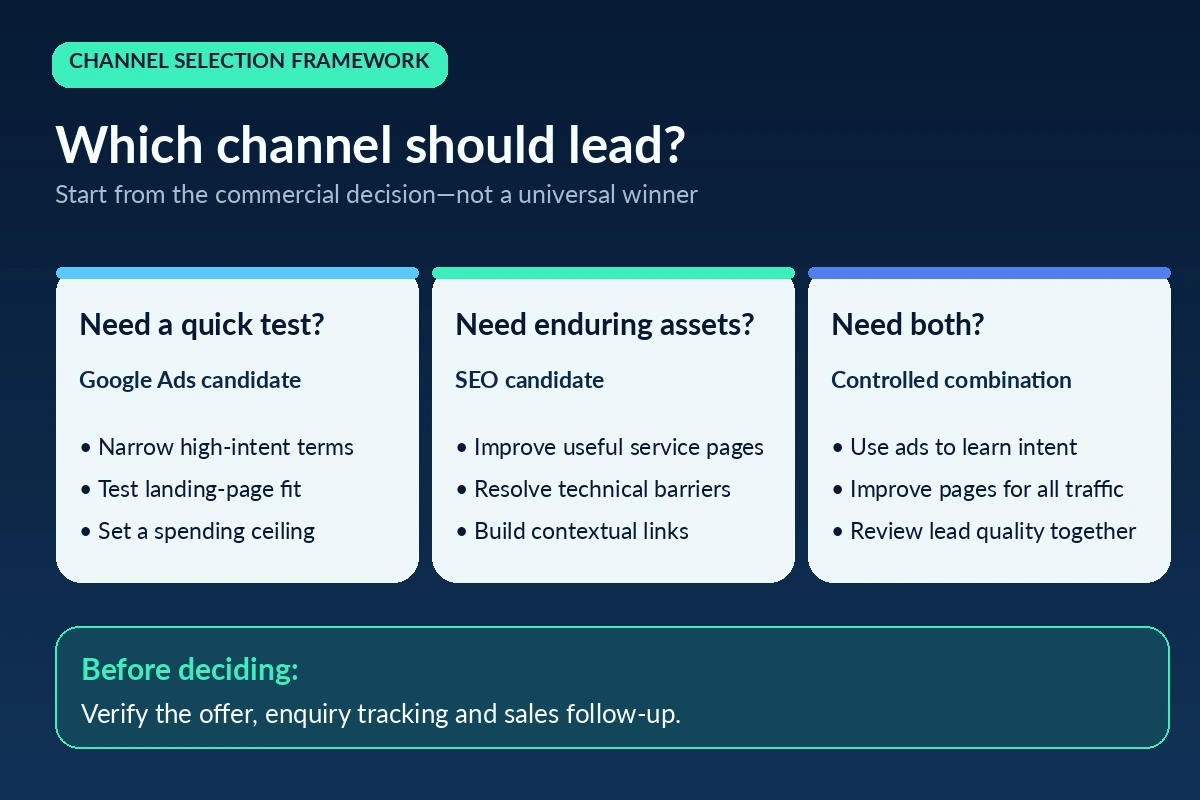
First, identify the business service that can handle additional demand. Second, list the buyer’s decision questions and the geographic market you actually serve. Third, inspect existing service pages, mobile experience and contact routes. Fourth, define a qualified inquiry with sales. Fifth, decide whether your immediate objective is demand testing, durable educational visibility, or both. Sixth, allocate resources for measurement and follow-up. Finally, review actual outcomes and change course when evidence contradicts assumptions. A small company may start with one channel while fixing the foundations needed for the other.
Using both channels responsibly
Paid-search query insights can reveal language buyers use, but a term that attracts ad clicks does not automatically deserve a new SEO page. Conversely, useful organic content may help buyers compare options after an initial ad visit. Keep commercial service pages distinct from explanatory guides, avoid creating multiple pages for the same intent, and track changes to the website alongside campaign changes. If there is no capacity to respond to inquiries, improving that workflow may be more urgent than increasing traffic.
Questions to ask an agency or internal team
Ask what the first month will deliver, which landing pages need work, how inquiry quality will be measured, who owns tracking and form testing, what is excluded from the fee, and how recommendations will be reviewed. Ask how the team handles uncertainty and when it would advise against spending more. A responsible plan describes deliverables and review checkpoints without guaranteeing a top ranking, a fixed number of leads, or a universal return on investment.
What to do next
Audit one commercially important service page and its contact path. Review the last set of inquiries with sales and identify why some were unsuitable. If the business needs rapid market feedback and can fund a controlled test, consider a narrow paid-search experiment. If core pages are incomplete or inaccessible, address those issues and build useful search-focused content. Revisit the choice as evidence accumulates. The better channel is the one that helps the business learn and serve suitable buyers within its actual resources.
Build a decision around buyer intent, not channel labels
Consider the difference between someone searching for a definition and someone requesting a quotation. Both searches can be relevant, but they require different responses. An Egyptian facilities-management company might find educational queries about maintenance planning useful for earning attention, while a buyer searching for a commercial maintenance contract in Cairo may need a service description, geographic coverage and a clear way to request an assessment. Neither query proves the searcher will buy. Write down what each important query suggests about the buyer’s stage, then check whether the landing page answers that stage’s questions.
Do not treat every search phrase as an instruction to create a new article. A single detailed service page may serve several close variants. Separate pages are justified when the actual offer, audience or decision questions differ substantially. This protects visitors from navigating a collection of near-identical pages and helps the team maintain accurate information. For a practical view of the organic work involved, see the site’s SEO agency guide for Egypt; it should be read as context rather than evidence of a guaranteed outcome.
How to structure a limited paid-search test
Start by documenting the hypothesis: which service, which customer, which geography and which action would count as meaningful interest? Choose a landing page that matches the advertisement. If the business serves only a few governorates, say so rather than attracting inquiries it cannot fulfil. Verify that the contact form works, that a response reaches the responsible team and that someone can distinguish a serious request from a generic message. Decide in advance how long the experiment can run and what budget limit the business can afford to lose without harming operations.
Before interpreting results, inspect the actual queries and campaign settings. Broad matching can expose ads to searches that differ from the original keyword, and exclusions may be necessary. Check location settings, device experience and the wording of calls to action. A high click-through rate can coexist with unsuitable inquiries. Equally, a small number of inquiries may be meaningful if the buyer’s need matches the company’s capacity. The Google Ads explanation of search terms provides a starting point for understanding how the query report relates to keyword targeting. Available reporting and settings vary by campaign type.
What an SEO-first project should actually deliver
Organic search work should begin with a baseline rather than an arbitrary publishing quota. Confirm that priority pages are accessible, internally linked and understandable to a visitor who has never heard of the company. Review whether a page explains who the service is for, what is included, what is excluded, where it is offered and how a prospect can assess fit. Where the business has no permission to show client work, describe the process honestly rather than inventing a case study. Technical checks may include indexing signals, canonical choices, redirects, mobile usability and page performance, but the diagnosis should determine which fixes are necessary.
For organizations comparing providers, the distinction between an SEO companies comparison and a specific agency service page matters. A comparison guide should help the reader evaluate options and evidence, not simply repeat sales copy. A service page should explain a particular deliverable and its boundaries. Avoid merging the two intents just to target more keywords.
Use a measurement plan that sales can recognize
Agree on a short set of definitions before launching either channel. An inquiry may be a form submission, phone conversation or booked consultation; a qualified opportunity requires additional criteria that the sales team accepts. Record the origin when it is available, but allow for uncertainty when a buyer researches through several visits or devices. Test events with real internal test submissions before trusting a dashboard. Do not count every click on a contact button as a completed sales conversation.
For organic discovery, Search Console’s performance report can help distinguish impressions, clicks, queries and pages. These figures do not directly establish revenue. For website actions, Google Analytics events can support measurement when correctly configured and subject to the site’s consent and privacy practices. For paid media, compare campaign reporting with the inquiries that the sales team actually receives. A dashboard discrepancy is a reason to investigate tagging, attribution or processing delays, not automatically to declare one platform wrong.
Assess total cost and operational capacity
Paid-search cost includes more than media spend. Someone must build and maintain campaigns, review queries, improve landing pages, test tracking and follow up with prospective customers. Organic-search cost also extends beyond an initial article: research, technical fixes, design, fact checking and updates all require resources. An appropriate comparison considers the same business objective and includes the team’s ability to serve demand. A company that cannot respond promptly may gain little from increasing either channel’s traffic.
Build a simple internal worksheet without pretending that industry averages predict your business. For each channel, record the planned spend, team hours, number of suitable inquiries, number of meaningful sales conversations and any confirmed outcomes. Keep assumptions separate from observations. If there are too few observations to draw a conclusion, say so. For a broader view of channels and the supporting website work, the published Google Ads management service can help identify the components a plan may require.
Review the landing page before judging traffic quality
A prospective buyer should be able to identify the offer within seconds, then find enough detail to decide whether to inquire. Check headings, scope, geographic availability, evidence, mobile layout, accessibility and the contact route. If a company sells complex B2B services, a useful next action may be requesting a requirements discussion rather than making an immediate purchase. Avoid promising instant quotations where an assessment is genuinely necessary. The same page-quality improvements often benefit visitors arriving from paid ads, organic search, referrals and direct traffic.
For service businesses with multiple audiences, do not force all visitors into one generic landing page. A procurement manager may need compliance and implementation details; a small-business owner may first need a plain-language explanation of the service. Distinct pages are helpful only when the underlying content is genuinely different and maintained. This is a content-architecture decision, not a justification for duplicating paragraphs with new city names.
A 30-day review cycle without invented targets
In the first week, confirm business priorities, audit the existing website and agree on qualification criteria. In the second, fix obvious inquiry-path problems and prepare either a tightly scoped paid test or improvements to the most relevant organic service page. In the third, verify that tracking is working and collect feedback from people handling inquiries. In the fourth, review what can actually be learned: which queries are attracting attention, which messages are misleading, where prospects abandon the process and whether follow-up is timely. A month may be enough to uncover problems or test messaging; it is not a universal deadline for organic ranking gains or statistical confidence.
Write the next decision explicitly. Continue, narrow, pause or change the offer based on documented observations. If the data cannot distinguish between alternatives, design a better measurement step rather than asserting that one channel won. The aim is an accountable decision process, not a manufactured success story.
Questions worth resolving before hiring support
Ask who owns the advertising account, analytics property and website access. Ask whether landing-page development, copywriting, technical fixes and sales-system integration are included or separately scoped. Request examples of reporting formats without requiring confidential client data. Ask how an agency handles uncertainty, what changes require approval and what evidence would cause it to recommend reducing spend. A credible provider should be comfortable explaining constraints and the work that has not yet been validated.
To discuss which channel fits your business, share the offer, its landing page and how soon you need enquiries. If you have previous campaign or sales data, include the cost of a qualified enquiry and the proportion that became customers.
Final decision: choose a sequence you can sustain
There is no universal winner between SEO and Google Ads for Egyptian businesses. A company with an urgent, narrowly defined offer may learn from controlled paid search while improving its website. A company with incomplete service information may benefit more from making its core pages accurate and usable before buying traffic. Some organizations can support both approaches; others should concentrate resources on the most testable priority. Review the decision against qualified demand, operating capacity and evidence—not impressions or traffic alone.





No comment